Available for Purchase
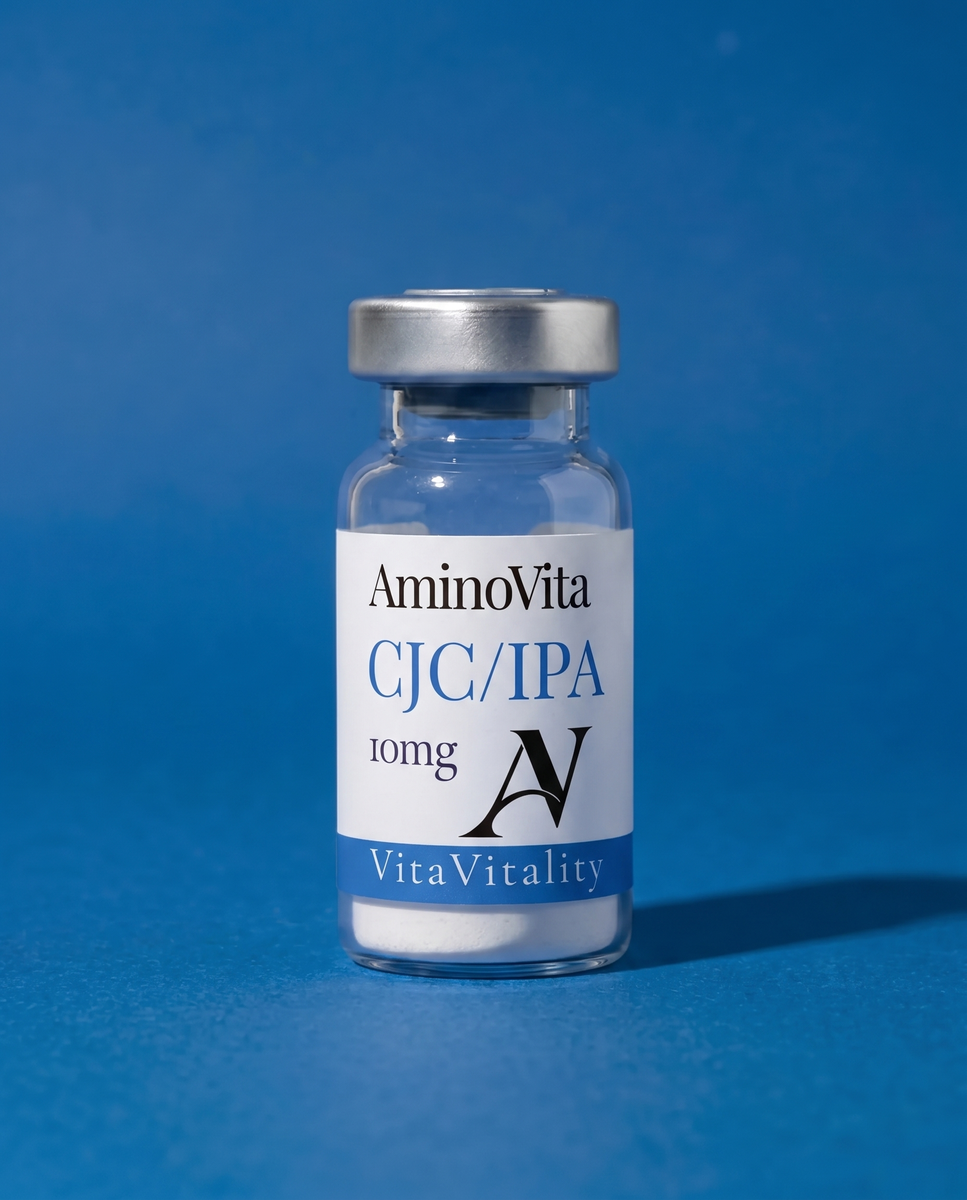
CJC/IPA 10mg
5mg CJC w/o DAC + 5mg Ipamorelin · ≥ 99% HPLC each · Batch-specific COA
$80.00
View ProductDual-Pathway Growth Hormone Pulse
One vial, two receptors. CJC w/o DAC gives the tonic elevation. Ipamorelin gives the selective pulse. Together they produce a larger, cleaner GH release than either compound can produce alone.
Vial Composition
5mg CJC + 5mg IPA
Receptors Targeted
GHRH-R · GHS-R1a
Purity (HPLC)
≥ 99% each
In Plain English
Think of the pituitary as a warehouse full of growth hormone with two independent shipping doors. Your body normally decides how much GH to release by pushing on one door with GHRH (the "release" hormone) and pulling on a brake with somatostatin (the "wait" hormone). Ghrelin — the hunger peptide — can also push, through a second, separate door called GHS-R1a.
CJC w/o DAC is a modified copy of GHRH. It binds the first door harder and lasts longer than the natural signal. Ipamorelin is a small synthetic peptide that mimics ghrelin at the second door — but only at that door, without ghrelin's appetite-stimulating side effects. Together they open both shipping doors at once.
The reason researchers pair them is that the two signals aren't redundant, they're additive. Opening door one by twice as much would eventually saturate that receptor. Opening two different doors at once moves more product without pushing either receptor into desensitization, and the body's brake (somatostatin) still works normally so nothing runs away.
Older growth-hormone secretagogues — GHRP-2, GHRP-6, hexarelin — also hit that second door, but they hit nearby receptors too, which is why they bump cortisol and prolactin. Ipamorelin was designed to be selective specifically to avoid that. So the blend gives you the amplitude of a two-receptor push without the collateral endocrine noise.
Plain English: CJC pushes one growth-hormone-release lever; Ipamorelin pushes a different one selectively. Using both at once produces a larger, cleaner pulse than either can produce alone.
How It Works
The CJC component binds GHRH-R on pituitary somatotrophs and triggers the cAMP / PKA cascade. The Ipamorelin component binds GHS-R1a on the same cells and triggers Ca2+ / phospholipase-C. Two independent signaling pathways converging on the same GH-secreting cell population.
CJC w/o DAC has a ~30-minute plasma half-life — long enough to hold a tonic elevation of the GHRH signal. Ipamorelin's ~2-hour half-life delivers a sharper, receptor-driven pulse over the same window. The natural GHRH/ghrelin duet the body was designed to receive, in one reconstituted solution.
Older GH-releasing peptides (GHRP-2, GHRP-6, hexarelin) hit GHS-R1a but also cross-react with receptors that drive cortisol and prolactin. Ipamorelin was engineered to bind GHS-R1a selectively, so the combined push on GH release doesn't carry those collateral endocrine signals.
Evidence
Synergy
Research in animal and cell-culture models reports that co-administering a GHRH analog with a GHS-R1a agonist produces a GH pulse of greater amplitude than either compound produces alone at equivalent doses — consistent with the two-receptor push activating two independent signaling cascades in the same somatotroph.
Takeaway: The pairing isn't additive by dose; it's additive by mechanism.
Selectivity
Ipamorelin's binding profile is unusually clean for a GHS-R1a agonist. Published assays report that at doses producing meaningful GH release, cortisol and prolactin remain at baseline — a departure from earlier compounds like GHRP-2 and GHRP-6, which elevate both.
Takeaway: The amplification stays on the GH axis without dragging the stress axis along with it.
Preserved Feedback
Because both peptides act upstream at the pituitary rather than replacing endogenous GH, the body's negative-feedback loop (somatostatin release triggered by rising IGF-1) still applies. The pulse rises and falls within the pattern the system was designed to receive.
Takeaway: Amplification without runaway — the "stop" signal remains intact.
Circadian Alignment
The largest natural GH pulse occurs during slow-wave sleep. In sleep-research designs, GHRH-analog + GHS-R1a-agonist protocols timed to the nocturnal window have been used to explore whether amplifying that pulse changes downstream IGF-1 kinetics or slow-wave duration.
Takeaway: The blend is often studied in circadian, sleep-architecture, and IGF-1 axis designs.
Available for Purchase
5mg CJC w/o DAC + 5mg Ipamorelin · ≥ 99% HPLC each · Batch-specific COA
$80.00
View ProductFurther Reading
The CJC Half
How the GHRH analog binds its receptor, why the "without DAC" version behaves differently from the long-acting form, and what the clinical data reports about GH and IGF-1 elevation.
The IPA Half
Why Ipamorelin activates GHS-R1a without touching the receptors that drive cortisol and prolactin — the selectivity that makes the CJC/IPA pairing clean.
FAQ
The two compounds act on different pituitary receptors — CJC w/o DAC on GHRH-R and Ipamorelin on GHS-R1a — through separate signaling cascades (cAMP/PKA and Ca2+/PLC respectively). In cell-culture and animal research, pushing both receptors at once produces a larger amplitude GH pulse than either compound alone, without additional side signaling.
Chemically, yes — the CJC/IPA vial contains 5mg of each peptide, the same amounts you'd get in two separate 5mg vials. The blend is convenient for research protocols that always reconstitute the two together at a fixed ratio; single-compound vials give you flexibility to vary that ratio.
Yes. CJC w/o DAC has a plasma half-life of roughly 30 minutes and produces a longer tonic elevation of GH signaling. Ipamorelin has a plasma half-life of about 2 hours and produces the sharper receptor-driven pulse. Together they mimic the natural biphasic pattern of GHRH + ghrelin more closely than either alone.
Ipamorelin is unusually selective for GHS-R1a compared to earlier GHRPs like GHRP-2, GHRP-6, and hexarelin. Those older compounds have off-target activity on receptors that drive cortisol and prolactin release. Ipamorelin's structure minimizes that cross-reactivity, so the amplification stays on the GH axis without the collateral endocrine signals.