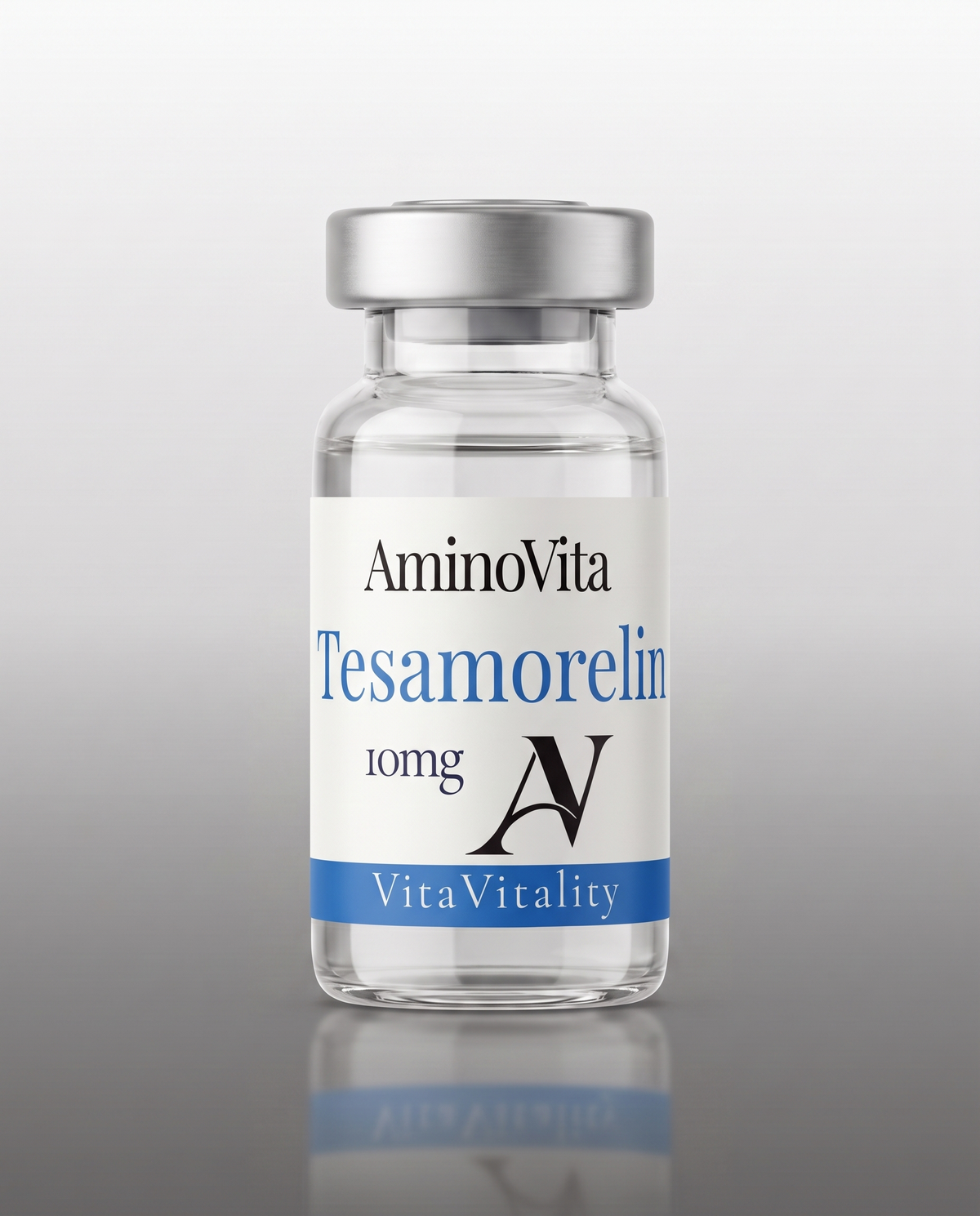
Available for Purchase
Tesamorelin 10mg
99%+ HPLC-verified · MS-confirmed · Batch-specific COA
$75.00
View ProductThe Visceral Fat Researcher's Compound
The only growth hormone-releasing compound that's actually received regulatory approval for a specific condition. Researchers study it primarily for its effects on stubborn belly fat and body composition.
Molecular Weight
5,135.83 Da
CAS Number
218949-48-5
Structure
GHRH(1-44) analog
In Plain English
Visceral fat — the fat packed around your organs, not the pinchable kind under your skin — is the most metabolically dangerous type. It acts like an endocrine organ, pumping out inflammatory signals that drive insulin resistance, cardiovascular risk, and chronic disease. And it's notoriously resistant to diet and exercise alone.
Tesamorelin is a synthetic analog of GHRH (Growth Hormone Releasing Hormone). It preserves the complete 44-amino-acid GHRH(1-44) sequence and adds a trans-3-hexenoic acid modification at the N-terminus, which resists cleavage by dipeptidyl peptidase-4 (DPP-IV). The structural result is a GHRH receptor agonist with an extended in-vitro half-life relative to native GHRH and full native binding affinity for GHRHR.
What makes Tesamorelin distinctive in the GHRHR-agonist literature is receptor-pharmacology selectivity. In-vitro adipocyte models exposed to GH released via GHRHR activation demonstrate preferential lipolysis in visceral-origin adipose tissue relative to subcutaneous-origin tissue. The mechanistic basis is thought to involve differential GH-receptor density and lipolytic-enzyme responsiveness across adipose depots.
The compound's receptor-pharmacology extends beyond adipose tissue — GHRHR is also expressed in central nervous system tissue, and downstream GH/IGF-1 axis signaling has been characterized in a variety of neuronal and glial cell models.
Plain English: Tesamorelin is a full-length GHRH analog. In-vitro, it signals through the GHRH receptor and stimulates GH release from pituitary-derived cell lines, with downstream effects on IGF-1 axis pharmacology that show adipose-depot selectivity in laboratory models.
How It Works
Unlike CJC-1295 (a truncated analog), Tesamorelin preserves the complete 44-amino-acid GHRH sequence. The trans-3-hexenoic acid modification protects it from DPP-IV enzymatic degradation, extending its functional half-life while maintaining the full native receptor interaction.
The GH released by Tesamorelin stimulation triggers lipolysis preferentially in visceral adipose tissue. Research shows significant reductions in trunk fat (measured by CT scan) without proportional changes in subcutaneous fat — suggesting a selective mechanism on deep abdominal fat stores.
Beyond direct fat reduction, Tesamorelin has been studied for improvements in triglyceride levels and other lipid markers. The reduction in visceral fat may itself drive downstream improvements in metabolic health, as visceral adipose tissue is a major source of inflammatory cytokines.
Evidence
Adipocyte Pharmacology
In-vitro adipocyte models exposed to GH released via GHRHR activation demonstrate preferential lipolysis in visceral-origin adipose tissue relative to subcutaneous-origin tissue. The response is measurable via glycerol release assays and hormone-sensitive lipase phosphorylation.
Takeaway: In laboratory models, the GHRHR → GH → lipolysis pathway shows an adipose-depot preference that is not seen with direct GH agonism — a distinguishing feature of GHRH-mediated activation.
CNS Receptor Distribution
GHRHR is expressed in hippocampal and cortical tissue and has been characterized in a range of in-vitro neuronal and glial cell models. Downstream GH/IGF-1 axis signaling has been examined in the context of neurotrophic pathway pharmacology and amyloid-beta interaction.
Takeaway: Receptor-pharmacology relevance to CNS models is an active area of in-vitro investigation distinct from the peripheral GH/lipolysis axis.
Cell-Model Selectivity
In vitro, GHRHR-mediated GH release drives measurable lipolytic activity in adipocyte lines without a comparable catabolic signature in skeletal-muscle-derived cell models. The pathway divergence is attributed to differential GH-receptor signaling downstream of ligand binding.
Takeaway: The GHRH → GH pathway shows compartment-selective effects in laboratory cell models — adipose-lipolytic response is dissociable from muscle-catabolic response.
Structural Distinction
Unlike GHRH(1-29) analogs such as CJC-1295, Tesamorelin retains the full GHRH(1-44) sequence. The additional 15 residues at the C-terminus contribute to receptor-binding kinetics that differ from truncated variants in in-vitro binding-affinity and dissociation-rate assays.
Takeaway: Full-length preservation is the distinguishing structural feature of Tesamorelin relative to other GHRH agonists in the receptor-pharmacology literature.
Available for Purchase
99%+ HPLC-verified · MS-confirmed · Batch-specific COA
$75.00
View ProductFurther Reading
FAQ
Structurally, Tesamorelin preserves the full 44-amino-acid GHRH(1-44) sequence and adds a trans-3-hexenoic acid N-terminal modification that resists DPP-IV cleavage. Compared to truncated analogs, this design retains native GHRH-receptor binding affinity while extending in-vitro half-life. It is one of the most characterized GHRH agonists in the peer-reviewed pharmacology literature.
Tesamorelin is a full 44-amino-acid GHRH analog (the complete native sequence) with a trans-3-hexenoic acid modification. CJC-1295 is a truncated 30-amino-acid fragment with amino acid substitutions and an optional DAC modification. Tesamorelin has regulatory approval; CJC-1295 does not.
Subcutaneous fat is the "pinchable" fat under your skin. Visceral fat wraps around your internal organs. While subcutaneous fat is relatively metabolically inert, visceral fat acts like an endocrine organ — secreting inflammatory cytokines that drive insulin resistance, cardiovascular disease, and systemic inflammation.
Clinical trials showed that Tesamorelin's visceral fat reduction occurred without significant worsening of HbA1c or glucose tolerance. This is noteworthy because exogenous GH can impair insulin sensitivity. Tesamorelin's physiological, pulsatile GH release appears to avoid this concern.